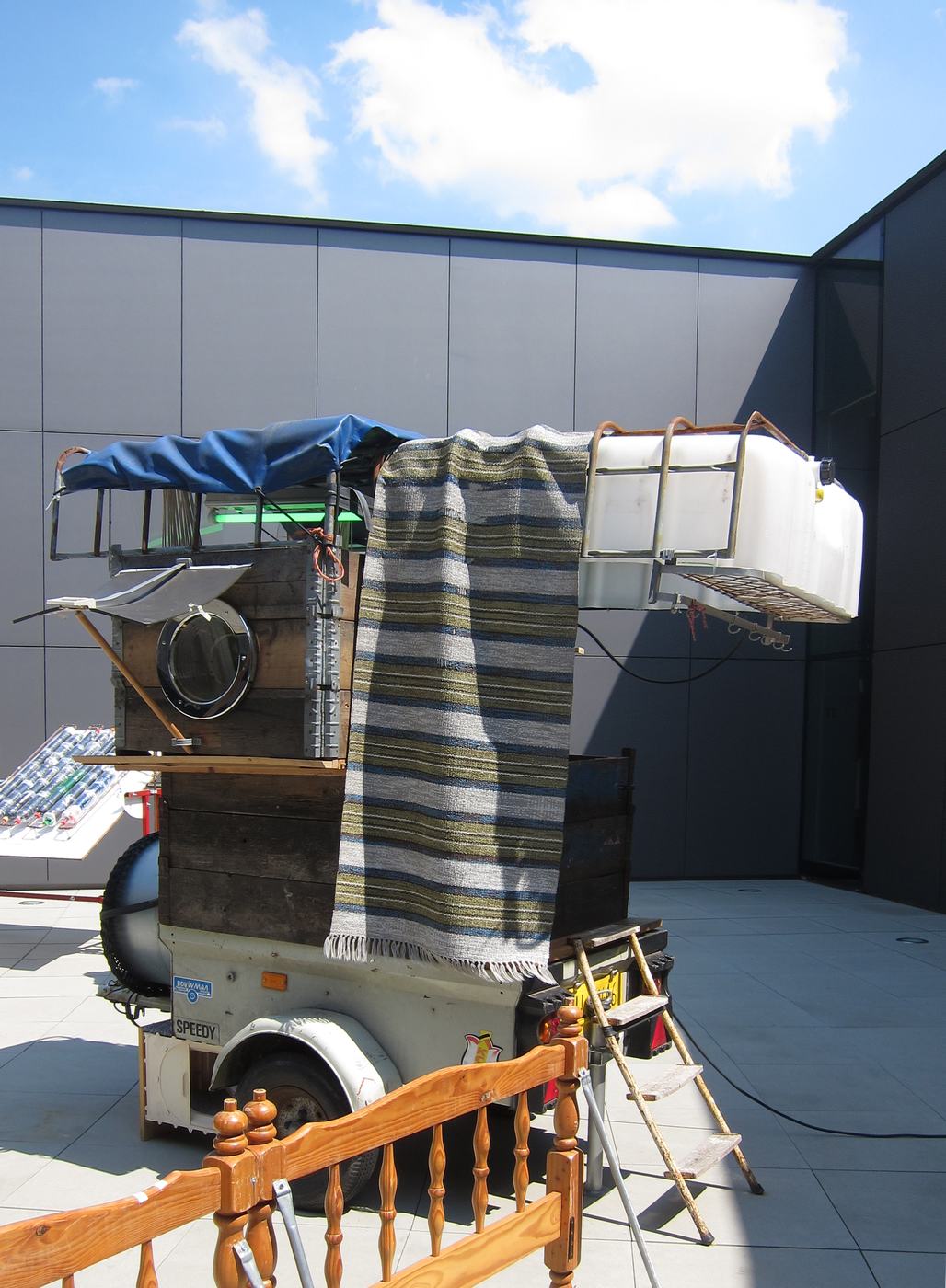
A trailer, a heap of discarded material, and one day. By the evening there is a house on it, and it drives away.

Build

You start from material, and from something to start it on. A pallet will do — that is already mobile, you can get a jack under it and move the whole house. On a trailer it is properly mobile: it drives off at the end of the day and it keeps going.

The rest is whatever the city put out: IBC tanks, a fridge door, pallet wood, tyres, a sheet of shop window. Nothing is bought and nothing is cut to a drawing — the material decides what the house becomes. By the end of the day it has a floor, a roof, a window that opens, and it stands on its own wheels.

An empty cart in the hall at the start of the day Working on the timber frame of the roof The house on its wheels, roof on, late in the afternoon The finished house lit from within after dark

Days, twenty seconds each

The first one on a trailer. It ends the day lit from the inside.
Another day, from one corner of the hall. The material walks in, the teams follow. Press play.

The same day, after dark

The last photographs of that first day were taken between half past seven and ten to eight in the evening. The house is finished, everyone is inside it, and the panels that were fridge doors in the morning are lit from within.

Two people sitting inside the house, looking out Someone framed in the round window, a washing machine drum The house glowing in the dark hall The finished house at the end of the evening

What you learn

Looking
You are not looking at a thing, you are looking at a part. A crate on the pavement stops being a crate somewhere between the street and the trailer, and the whole day depends on how early that happens.
Building
How a structure carries itself, and how far you can push a material before it tells you it has had enough.
Joining
Connecting things that were never meant to meet. A steel cage against a plastic tank against a plank — every pair needs its own answer.
Shifting functions
A fridge door stops being a fridge door. It is a wall panel with a window in it, insulated, hinged, and already the right size.
Harvesting
Where material comes from. How to see it before it is waste, how to get it out, and what it costs you to move it.

Design for succession

Nothing you build here is a final state. Every part arrived from an earlier use and is on its way to a later one, so you build it to come apart again — screwed rather than glued, clamped rather than welded. The house is one afternoon in a much longer life of the material.

Which is why nothing here gets disguised. The tank stays a tank: original colour, printed markings, the scratches and the wear left exactly as they were found. Nothing is repainted, nothing is sanded back to something neutral, and nothing is made to look old on purpose. It is cut and bolted, and it goes on saying out loud where it came from.

So the question in front of a heap of material is never what is this made of. It is what can this, as it is, be asked to do next. Functions are verbs — to carry, to close, to keep the rain out, to sit on — and a verb can be answered by almost anything that happens to be standing there. Waste is simply a resource that has not been asked yet.

How a day works

You work in teams, guided by Refunc. The material is there when you arrive, the trailer is empty, and the day ends when the house rolls. No experience needed — the making teaches it.

What the day is really doing is putting people and material back in the same room. Most of what you build with passed through a hundred hands before it reached the kerb, and none of those hands were yours. By the afternoon you know how heavy a full IBC cage is, which side of a pallet gives way first, and how a plank behaves under a screw that is one size too big — and that knowledge is the part of the day that goes home with you.

Two people stretching a sheet over the frame A team working on a tyre at the quay

Other days

It has happened many more times than these, in halls and on squares, with students, with neighbours, with whoever turned up. Every time the material is different, so every time the house is.

An outdoor build on a public square
Linz
1 / 11
The finished house standing at the quay under the cranes